How to Tell Before You Press
The listing will not tell you reliably. Three checks will, and the last one costs a single blank.
The Mechanism
Why Does Coating Matter At All?
Sublimation dye needs something to bond with. Polyester provides that on fabric. On a hard good, a polymer coating does the same job, which is why a coated ceramic mug works and the identical uncoated mug from a supermarket does not.
The coating is usually invisible to a casual glance. That is the entire problem, and it is why so many shops learn this by pressing forty units of something that was never going to work.
Check One
Read The Spec Sheet, Not The Listing
Sublimation dye needs something to bond with. Polyester provides that on fabric. On a hard good, a polymer coating does the same job, which is why a coated ceramic mug works and the identical uncoated mug from a supermarket does not.
The coating is usually invisible to a casual glance. That is the entire problem, and it is why so many shops learn this by pressing forty units of something that was never going to work.
- 1
Explicitly coated.
The spec says polymer coated, sublimation coated, or gives a coating type. Safe to quote.
- 2
Says sublimation ready with no detail.
Probably fine, worth one test unit before a bulk order.
- 3
Silent on coating.
Treat as uncoated until proven otherwise.
- 4
Says suitable for printing or decorating.
This usually points to a different method entirely. Assume uncoated.
Check Two
Look At The Surface
With the item in hand, there are things you can see before you commit to a press cycle.
A coated surface usually carries a slight sheen, even on a matte finish, and it looks uniform. Run a finger across it and it feels smooth and sealed rather than porous. Raw ceramic, bare wood and untreated stone feel different in a way that becomes obvious once you have handled both.
Look at the edges and the base too. Coating is often applied to the printable area only, so a mug can be coated on the barrel and raw underneath. That tells you it is coated, and it also tells you exactly how far the coating extends, which matters for placement.
None of this is conclusive on its own. It is enough to tell you whether to be optimistic or careful.
Check Three
Press One
When the listing is unclear and the surface is ambiguous, stop investigating and press one.
Buy a single unit. Run it at your normal settings for that substrate type. You will know within one cycle. A coated blank produces full, saturated color. An uncoated one produces something pale and patchy that wipes or scratches, because the dye had nothing to bond to.
This is the step people skip because it feels slow. It is the opposite. Ninety seconds and one blank buys you certainty on a product you may run hundreds of times.
Why Testing Is Cheap Here
What Makes A Single-Unit Test Practical
Pressing one unit to answer a question only works if a run of one is a normal thing for your shop to do.
On a Sawgrass system it is. There is no screen to burn, no cut file to build, and no minimum quantity that a setup has to be spread across. The cost of testing a blank is the blank, a sheet of paper and a press cycle, which is why you can afford to be curious about a new product rather than cautious about it.
That matters more than it sounds. Shops that can test cheaply end up with wider and better sourced product lines, because they can say yes to an unfamiliar blank and find out. Shops that cannot end up buying only what they already know.
Cotton And Natural Materials
Does Everything Need A Coating?
No, and this is where the coating question stops being the only question.
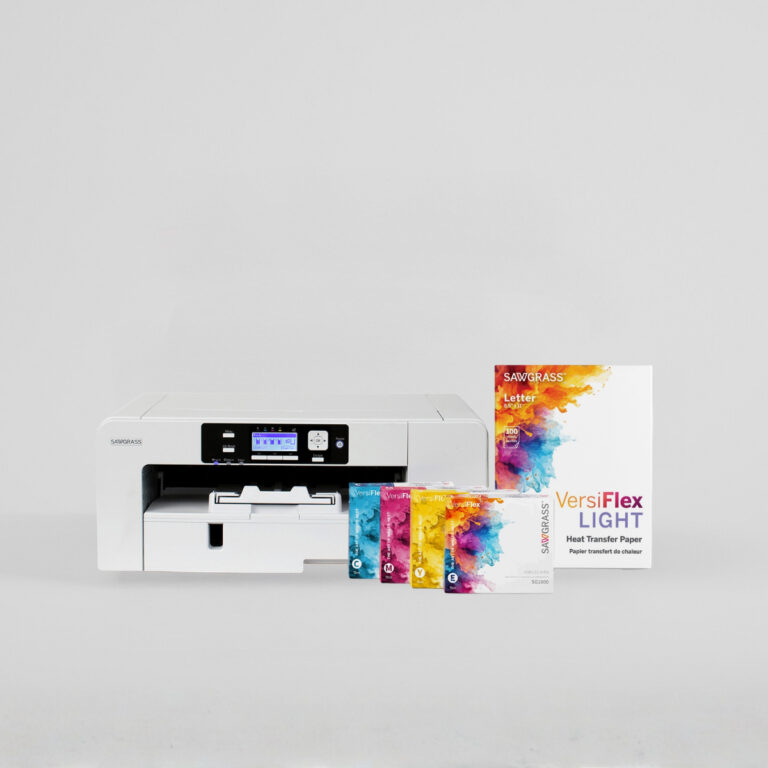
Coating matters for traditional sublimation on hard goods, which runs on TruePix sublimation paper. Cotton, natural fabrics and uncoated wood run on VersiFlex Light Transfer Paper instead, from the same Sawgrass printer and the same VersiFlex Ink Set.
So an uncoated blank is not automatically a dead end. It is a question about which paper the job needs. Bare wood that would fail a sublimation test is a normal VersiFlex job. Worth checking before you write off a product you liked.
On natural materials specifically, test first regardless. Surface texture, porosity and color all affect the result, and a sample piece will tell you more than any spec sheet.
Common Questions
Coated Blanks, Answered
Can you sublimate on an uncoated mug?
No. Sublimation dye needs a polymer coating to bond with on a hard surface. An uncoated ceramic mug produces a pale, patchy image that scratches or wipes away, because nothing held the dye. Check the manufacturer spec before ordering in quantity.
What does sublimation ready actually mean?
It is marketing language rather than a specification, and it is not regulated. Some sellers use it accurately for polymer-coated items, others use it loosely. Treat it as a reason to test one unit rather than as confirmation, and check the manufacturer listing.
How can I tell if a blank is coated by looking at it?
Coated surfaces usually show a slight sheen even when matte, and feel smooth and sealed rather than porous. Check the base and edges, since coating is often applied only to the printable area. Visual checks narrow it down but do not confirm it.
Why did my print come out faded on a hard good?
The most common causes are an uncoated or poorly coated blank, insufficient time or temperature, or inconsistent pressure. Rule out coating first by testing a blank you know is coated. If that one prints correctly, the issue is the substrate rather than your settings.
What can I decorate that is not coated?
Cotton, natural fabrics and uncoated wood run on VersiFlex Light Transfer Paper, using the same Sawgrass printer and VersiFlex Ink Set you already have. Test natural materials on a sample first, since texture, porosity and color affect the result.
What To Do This Week
Test Before You Commit The Shelf
Pick the blank you have been curious about and buy one. Press it. Write down what happened next to the supplier name, and you have started a reference that gets more valuable every time you add to it.
Coating is one of three checks worth running before you accept any job. The other two are in 3 Questions To Ask Before An Order.
Coated Or Not, One Printer Covers It
Sawgrass VersiFlex runs coated hard goods on TruePix sublimation paper and cotton, natural fabrics and uncoated wood on VersiFlex Light Transfer Paper. Same machine, same ink set.